
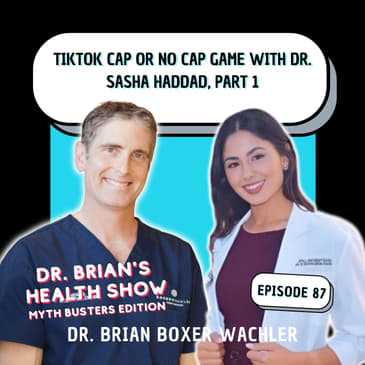
Welcome to The Dr. Brian’s Health Show, a weekly podcast where Dr. Brian Boxer Wachler uses his decades of experience in medicine and ability as an expert researcher to provide a light-hearted approach and share health trends popular on TikTok. In this episode, Dr. Brian welcomes Dr. Sasha Haddad to the show to discuss...
Is it possible for fully grown adults to grow even more? What can you do to improve regularity? Find out in today’s episode!
If you’re enjoying the show, we’d love it if you leave the show a Rating & Review at RateThisPodcast.com/NoCap
Key Takeaways
01:15 – Dr. Brian introduces today’s guest, Dr. Sasha Haddad, who joins the show to discuss the difference between osteopathic and allopathic medicine
11:53 – Is it possible for fully grown adults to grow even more?
15:55 – Consuming organ meats and getting better sleep
21:46 – What can you do to improve regularity?
27:32 – Dr. Brian thanks Dr. Sasha for joining the show for Part One of this series, teases Part Two, and lets listeners know where they can connect with her
Tweetable Quotes
“The theory is that the structure and function are interrelated. And when one is off, the other is gonna be off. For example, if you have muscle pain, let’s say your spine is not in the right position, it’s gonna strain the surrounding muscle and tissue. So, if you’re able to adjust and correct the problem, you’re gonna fix the surrounding area and reduce the inflammation.” (08:39) (Dr. Sasha Haddad)
“In life, is anything possible? By nature, very rarely, potentially, maybe. But, medically speaking, by the time you hit puberty - in terms of bone width and height growing taller - I highly disagree, unless something pathologically happened differently.” (13:50) (Dr. Sasha Haddad)
“For the most part when you eat raw meat, the nutrients are present. And, of course, building blocks and protein can help.” (17:21) (Dr. Sasha Haddad)
“I agree, don’t spend your money on something that you don’t necessarily need. What’s better is down time.Try to limit yourself from being on your phone or on your computer a few hours prior to going to sleep. I think that’s way better than all of this.” (19:41) (Dr. Sasha Haddad)
“I think people can take fiber, but it doesn’t help if you’re not hydrating well. So, the key element here is you have to be able to hydrate. You have to have enough fluids in you to have things go through.” (24:59) (Dr. Sasha Haddad)
Resources Mentioned
DM Dr. Brian your questions and he will respond back with answers
Please remember, Dr. Brian is a doctor, but he is not your doctor. He is here to provide general information, not medical advice, so you should always check with your doctor before relying on any information.
Podcast Production & Marketing provided by FullCast
[00:00:00] [SPEAKER_01]: Welcome to Dr. Brian Boxer Wachler's Health Show. Dr. Brian will pull the curtain back on viral TikTok
[00:00:05] [SPEAKER_01]: health videos and label them as cap, false or no cap. True. Even if you aren't on TikTok,
[00:00:12] [SPEAKER_01]: now is the time to get on board, have fun and join his podcast. Dr. Brian is a board-certified
[00:00:18] [SPEAKER_01]: eye surgeon, specializing in advanced lacych, Kara Tacona, Wider Eyes, Dry Eyes, Cataract
[00:00:25] [SPEAKER_01]: Surgery and Reading Vision Improvement at the Boxer Wachler Vision Institute in Beverly
[00:00:29] [SPEAKER_01]: Hills, California. Also, please remember Dr. Brian is a doctor, but he is not your doctor.
[00:00:36] [SPEAKER_01]: He is here to provide general information, not medical advice, so you should always check
[00:00:41] [SPEAKER_01]: with your doctor before relying on any information.
[00:00:44] [SPEAKER_04]: Welcome everyone to the Health Show and I've got a very special guest today and I'm sure
[00:00:50] [SPEAKER_04]: you've seen her a lot. Dr. Sasha Haddad and she has her handle of one's puna doctor
[00:00:58] [SPEAKER_04]: on Oliver accounts, she's on TikTok, she's on Instagram, she's on YouTube and she's
[00:01:03] [SPEAKER_04]: just like this huge like positive ball of energy out there. And welcome to the show.
[00:01:10] [SPEAKER_03]: I'm so excited. Thank you so much for bringing me on. King of all capses, right?
[00:01:16] [SPEAKER_03]: Not too far away. Not too far away at all. I feel me that cap after the sex.
[00:01:23] [SPEAKER_04]: So what we're going to do today with Dr. Haddad is we're going to go through some videos, but before
[00:01:29] [SPEAKER_04]: we do that it's always nice to get to know the guests. So I know a little bit about her.
[00:01:34] [SPEAKER_04]: I'm going to give you a little bit of background. I'm going to have her take it from there,
[00:01:37] [SPEAKER_04]: but I know that you went orange coast college down in the South of Orange County and I do
[00:01:43] [SPEAKER_04]: have a quick little story. So I used to row and race against the OCC crews when I was at
[00:01:50] [SPEAKER_03]: the OCC. Oh my god, I did not know that. But I don't know. I think I'm going to bet on you
[00:01:56] [SPEAKER_03]: Sally wrote him over OCC on this one personally, but you know they were great. But our tennis team
[00:02:02] [SPEAKER_04]: was good. Tennis team was good too. I mean, I'll tell you, they had a great athletic program because
[00:02:08] [SPEAKER_04]: on their website, they have like for the rowing team on the rowing website, the OCC Orange
[00:02:13] [SPEAKER_04]: Coast College, they had the slogan Giant Killers because they were a small program,
[00:02:20] [SPEAKER_04]: but they were really good. And I don't know how they are now. I mean it's been a few years
[00:02:24] [SPEAKER_03]: since college. They've for me about truthfully. I agree. I mean, I had a great experience. I
[00:02:29] [SPEAKER_03]: were in Coast College and I think they're so adventurous. They have a lot of good programs
[00:02:33] [SPEAKER_03]: and they're expanding. And last time I heard when I transferred because I went to OCC Davis,
[00:02:38] [SPEAKER_03]: they're actually trying to make it into a Cal State. So I think they're expanding. I don't know
[00:02:42] [SPEAKER_03]: they are in the process, but honestly it was a great program. A lot of different majors and they
[00:02:46] [SPEAKER_03]: excelled in different missions. And I played on tennis. I wasn't on the tennis team,
[00:02:51] [SPEAKER_03]: but that's my experience with the tennis athletic department. And that's why I'm like,
[00:02:54] [SPEAKER_03]: I heard of the rowing team. I know they had a base to where it was at Newport.
[00:02:59] [SPEAKER_03]: Yeah, they were in the place. Yeah. Yeah. That's how I heard them. Like,
[00:03:02] [SPEAKER_04]: I supported from a distance. Yeah. Well, the tennis player you'll appreciate that I've really
[00:03:07] [SPEAKER_03]: gotten into pickle ball lately. Oh, I'm into beach tennis now yesterday. I would.
[00:03:14] [SPEAKER_03]: I visited one of my colleagues. She lives in Santa Monica. And it was an unexpected trip and that
[00:03:19] [SPEAKER_03]: of normal like she placed tennis. And there was a whole team and marathon of beach tennis back
[00:03:25] [SPEAKER_03]: to back. And I think you know what? I think we should try beach tennis from now on with the weather
[00:03:29] [SPEAKER_04]: is better at things for that. Yeah. Indeed. Well, I've been loving pickles. So maybe you might
[00:03:35] [SPEAKER_03]: go over to the dark side at some point. Okay. Maybe I think I'm right on the dark side.
[00:03:40] [SPEAKER_04]: Does it get darker from here? I'm not sure. Yeah, beach tennis. Okay. So why don't you take us back
[00:03:46] [SPEAKER_04]: about yourself so we get to know like where you grew up or you're from? I mean, going back,
[00:03:52] [SPEAKER_04]: but maybe not out to the womb, but you know, getting good back. Not to the old. I'll tell you.
[00:03:57] [SPEAKER_03]: So I was born here in Newport Beach and then I grew up in Lebanon. And then 2013, I moved back to the
[00:04:03] [SPEAKER_03]: States. That's when I went to Orange Coast College. And then I transferred to UC Davis. I got
[00:04:08] [SPEAKER_03]: my bachelor's degree in biological science at the time. It's some research to get gap here.
[00:04:13] [SPEAKER_03]: And with team gap here, I had some fun. I worked as a store manager for Agaprami and Fitch
[00:04:18] [SPEAKER_03]: behavior therapist for artistic kids. So I had some medicine, non-medicine. I was an artist. I did
[00:04:24] [SPEAKER_03]: run away for fashion. So it was a whole mixture of fun things. And then finally, I pursued and went
[00:04:29] [SPEAKER_03]: to medical school in Arizona, I went to 80 still, osteopathic medical school. Gradured and it came
[00:04:35] [SPEAKER_03]: back to California, and now we finally met a son of finishing off my residency. Let sounds great.
[00:04:40] [SPEAKER_04]: And I know you've got, you said one more year after this. Yeah. So you're starting to see a little
[00:04:44] [SPEAKER_03]: light at the end of the tunnel? Yeah. You know, I never saw the tunnel. I don't know what shape
[00:04:49] [SPEAKER_03]: we're in right now, but I don't think we're in the tunnel. I don't know direction anymore.
[00:04:54] [SPEAKER_03]: I think it's a bit clearer as we get through. Spoken like a true resident training.
[00:04:59] [SPEAKER_03]: Thank you. Thank you. Can you tell by the gray hair and the wrinkles?
[00:05:03] [SPEAKER_04]: You are getting there. Yeah, that means I'm a resident still. That's your criteria.
[00:05:09] [SPEAKER_04]: I'm still in residency. We'll believe it or not, I started off as a brunette. So
[00:05:15] [SPEAKER_04]: cap, we're a little bit like that. So maybe you can explain a little bit of the difference
[00:05:21] [SPEAKER_04]: between the two types of medical schools because you went to osteopathic medical school versus
[00:05:25] [SPEAKER_04]: like all allopathic. So like what's the difference with people understand? Actually, that's a very
[00:05:30] [SPEAKER_03]: good question because truthfully coming from an international background, I had no idea what
[00:05:35] [SPEAKER_03]: osteopathic medicine was until I accidentally wanted a conference at UC Davis. It was the health
[00:05:41] [SPEAKER_03]: pairs. And I actually went into a normal allopathic conference. It was booked out and I can
[00:05:51] [SPEAKER_03]: walk into a random conference and surprisingly it was an osteopathic medical board. And so
[00:05:56] [SPEAKER_03]: it was that or the dental conference. I had to pick one, I picked the osteopathic conference.
[00:06:02] [SPEAKER_03]: And that was my first time hearing about osteopathic medicine. And for me, it was a bit taboo
[00:06:07] [SPEAKER_03]: because not much was known abroad, especially in international, but what osteopathic medicine is.
[00:06:13] [SPEAKER_03]: And going back between the differences of osteopathic medicine, I would pathoc medicine,
[00:06:17] [SPEAKER_03]: going back there's a father called the father of 80 still. He's this, basically physician
[00:06:23] [SPEAKER_03]: was a doctor, Elopathic doctor, background back in the day. And he chose to do some of the
[00:06:28] [SPEAKER_03]: osteopathic medicine where they look at the entire body as a unit of mind body and spirit.
[00:06:33] [SPEAKER_03]: And the way that the approach is basically a most cool skeletal background with connecting
[00:06:38] [SPEAKER_03]: the different departments that impact your well-being. And at some point, there was emerged
[00:06:43] [SPEAKER_03]: between the Elopathic and the osteopathic. So now you have what we call an osteopathic program
[00:06:49] [SPEAKER_03]: in an elopathic structure. So you do everything that the Elopathic program does that means you're
[00:06:55] [SPEAKER_03]: taking all your requirements, your taking all your courses and mademy, pathology, physiology,
[00:07:01] [SPEAKER_03]: microbiology would take the same board exams. And at some point in California there was an
[00:07:05] [SPEAKER_03]: merge but then the osteopathic side decided to part out because of some sort of training.
[00:07:11] [SPEAKER_03]: So the differences that we have extra hours in our program of Muscles,
[00:07:15] [SPEAKER_03]: Cultural Training, we learn different methods and we look at the body a little bit differently.
[00:07:21] [SPEAKER_03]: So back in the day used to, you have someone come into the merge department,
[00:07:24] [SPEAKER_03]: you have a broken hand, what we do is we fix it and we send him home. But now we try to understand
[00:07:29] [SPEAKER_03]: all the different systems that impacted the fracture in the first place. So is this person coming
[00:07:35] [SPEAKER_03]: from a background of poverty? Did you have to work in construction that wasn't safe?
[00:07:39] [SPEAKER_03]: Was he under stress and depression that caused him to make an accident fall down break his hand?
[00:07:44] [SPEAKER_03]: In addition to that, a lot of conditions that are chronic conditions are just more than just
[00:07:49] [SPEAKER_03]: the physiology. It's not just the pathology of the problem. You'd realize that it's just more
[00:07:54] [SPEAKER_03]: complicated. So their focus was trying to connect all the little pieces and dots, bring it all together,
[00:08:00] [SPEAKER_03]: learn a bunch of techniques. Some of which can create things chronically. They target the
[00:08:05] [SPEAKER_03]: fascia, they target the muscle, they target the bones. And the theory is, a structure and function
[00:08:11] [SPEAKER_03]: are interrelated. And when one is off, the other is going to be off. For example, if you have
[00:08:16] [SPEAKER_03]: Muscle pain, let's say your spine is not in the right position. It's going to strain the
[00:08:21] [SPEAKER_03]: surrounding muscle of the tissue. So for able to adjust and correct the problem, you're going
[00:08:27] [SPEAKER_03]: to fix the surrounding area, reduce inflammation. Now, not to say in the end of the day,
[00:08:31] [SPEAKER_03]: our physicians, correct? So if someone's going to come in for a chest pain, you're not going
[00:08:35] [SPEAKER_03]: to adjust the spine. That's not how it works. A chiropractor also branch from the similar topic.
[00:08:40] [SPEAKER_03]: And their focus was the spinal structure and they do a lot of techniques called HVLA,
[00:08:45] [SPEAKER_03]: which is hydrolocity, of course, hydrolocity amplitude. And so basically, here, the cracking.
[00:08:51] [SPEAKER_03]: So they have a combination of physical therapy, muscle, tissue, fascia. And they bring everything
[00:08:57] [SPEAKER_03]: together and they're related to the condition. So the way that I see it is that you have an
[00:09:01] [SPEAKER_03]: additional tool set in your toolbox that you can offer the patient, some things extra help,
[00:09:07] [SPEAKER_03]: extra eye to help your patient out. But in the end of the day, I can get to same base. As you know,
[00:09:12] [SPEAKER_03]: we go the same resident these days. We take the same board exams. Yes, I had to do double at some
[00:09:17] [SPEAKER_03]: points. I could take complex end step because of some, you know, residences required. But I think
[00:09:23] [SPEAKER_03]: now after the merge, I was able to apply with both whether it's steps for a complex
[00:09:27] [SPEAKER_03]: for to the same residences. And that's where we are. I like that approach a lot because my own
[00:09:32] [SPEAKER_04]: personal experience, some I've had, for example, tendonitis, you know, from rowing in the elbow
[00:09:38] [SPEAKER_04]: and has injections, et cetera, in the past when I had it. But I really didn't get the final relief
[00:09:44] [SPEAKER_04]: until I went to a physical therapist who understood that, you know, it's like muscle tension here
[00:09:50] [SPEAKER_04]: that's pulling down on the tendon here. So even with my wife, she had really, really bad,
[00:09:58] [SPEAKER_04]: like you touched and she went like jumping off the table. He totally after like eight sessions
[00:10:03] [SPEAKER_04]: with her and left with me relaxed these muscles upstream that were pulling on the tendon
[00:10:11] [SPEAKER_04]: totally resolved. So that's just a great example of an allopathic approach even those physical
[00:10:16] [SPEAKER_04]: therapists, but you know, that's just making your point that yeah, they are interconnecting
[00:10:21] [SPEAKER_03]: systems. Yeah and I wanted to tell you know, even in our generation the thing that I'm seeing
[00:10:26] [SPEAKER_03]: beautifully. And I see this good overlap of the allopathic and osteopathic world because I think
[00:10:32] [SPEAKER_03]: right now when you go into medicine, people aren't just looking at the problem they're looking
[00:10:37] [SPEAKER_03]: at it person as a whole and I think that's the goal for every physician. Once I'm going to walk
[00:10:41] [SPEAKER_03]: in you're trying to figure out all the resources, of course, this and that's impacting them.
[00:10:46] [SPEAKER_03]: How can we help them? Where would they come from? What's the background story? And we're not just
[00:10:50] [SPEAKER_03]: trying to put that tape on the problem saying, okay, good luck, that's it. Take your medication,
[00:10:54] [SPEAKER_03]: come back. Yeah. So I think that there's this evolution, there's a lot of more thought and investment,
[00:11:00] [SPEAKER_03]: especially in two mental wellness and socioeconomic factors, especially in Los Angeles and California.
[00:11:06] [SPEAKER_03]: And hopefully I think that's a good overlap between both, which is something that it is again.
[00:11:10] [SPEAKER_04]: Yeah, I think in the future that gap's going to continue to narrow too.
[00:11:15] [SPEAKER_03]: I agree. Hopefully, eventually we can get rid of the gap. Yes.
[00:11:19] [SPEAKER_04]: I'll go. Mind the gap. Mind the gap. Exactly. Mind the gap. All right. Well, let's jump into
[00:11:24] [SPEAKER_04]: some of the TikTok videos because I know that's what everybody's here for and what we're
[00:11:29] [SPEAKER_04]: going to do is we're going to play the videos and then we'll have a discussion and I've got my cap
[00:11:35] [SPEAKER_04]: and you have your virtual cap and my virtual cap. And we'll see you in the next video.
[00:11:42] [SPEAKER_00]: Early in Harlem is still growing according to Manchester City doctors,
[00:11:46] [SPEAKER_00]: even though he's 23. He grew about a centimeter, pushing his height from six foot four to almost
[00:11:51] [SPEAKER_00]: six foot five. But how is this possible? Well, it's because he biohacks his body.
[00:11:57] [SPEAKER_00]: He eats foods like organ meats, oysters and raw milk, which increases testosterone,
[00:12:02] [SPEAKER_00]: a vital hormone needed for the production of human growth hormones. Along with that,
[00:12:08] [SPEAKER_00]: he also uses blue-like blocking glasses which protects a circadian rhythm. This increases the
[00:12:13] [SPEAKER_00]: quality of sleep, which also increases human growth hormones naturally. Which part of this
[00:12:19] [SPEAKER_04]: you want to do a diceack in this video? I don't know. I just love how it's just oozing
[00:12:24] [SPEAKER_04]: manliness like the voice is so like, manly. And it's about the soccer player who's eating organ meats.
[00:12:36] [SPEAKER_03]: It's a very hot, you know? I felt like I grew taller through the video, you know?
[00:12:41] [SPEAKER_03]: I see my biceps over here and bit the grew up too. I know there's so much going on with this video.
[00:12:46] [SPEAKER_03]: I didn't know where to start. I'm like, okay, let me take a step back. I think they're covering so much
[00:12:51] [SPEAKER_04]: in one video. Well, once you start doing your diceack in there, Sasha.
[00:12:55] [SPEAKER_03]: All right, you know, where do I start? Let's see. I'm going through this. You're the captain.
[00:13:02] [SPEAKER_03]: Let's start with a growing taller from the 6-4 to the 6-5. Oh yeah, okay, let's talk about this.
[00:13:09] [SPEAKER_04]: It's 23. It's 23. Is this even possible? Adult? Holy grown adult?
[00:13:16] [SPEAKER_03]: It's possible. If fully grown adult, in life is anything possible by nature, very early,
[00:13:25] [SPEAKER_03]: potentially, maybe. But medically speaking, by the time that hit purity and your growth plates
[00:13:34] [SPEAKER_03]: have views and everything has clothes and terms of bone width and high-growing taller,
[00:13:40] [SPEAKER_03]: I highly disagree. I highly doubt. Unless something pathologically happened different.
[00:13:45] [SPEAKER_03]: It could be maybe what people are seeing in terms of maybe they're measuring something differently.
[00:13:49] [SPEAKER_03]: It can happen from measurement to measurement. Is it a different meter that they're using?
[00:13:54] [SPEAKER_03]: Is it the clothing? Was he wearing shoes, not shoes in between measurements?
[00:13:59] [SPEAKER_03]: Are they measuring the different hair caught? Maybe people measured differently?
[00:14:02] [SPEAKER_03]: I think it could be, basically, if it's different, depends who's taking the measurement.
[00:14:07] [SPEAKER_03]: What meter they're using? The hairstyle is a different. I had long hair and a bunch,
[00:14:11] [SPEAKER_03]: or hair, not on your short hair. So medically speaking, height at the age of 23 after
[00:14:16] [SPEAKER_03]: Puberty thinks have views I'd tell. What do you think?
[00:14:20] [SPEAKER_04]: No, I totally agree with you. I'm just kind of nodding all the time.
[00:14:23] [SPEAKER_04]: I'm like, yeah, I'm just like rubber and equine it. Yeah. So that's a 23 year old.
[00:14:29] [SPEAKER_04]: The 23 year old. And now is quick. 23. 23 year old. You know, growth plates are huge.
[00:14:35] [SPEAKER_04]: I mean, the growth plates are fused. I think there's a lot of hope in a video like this
[00:14:42] [SPEAKER_04]: is going to attract a lot of attention because there's a lot of teenagers that want to get taller
[00:14:48] [SPEAKER_04]: even adults and this is giving them this hope. It's like they're
[00:14:54] [SPEAKER_04]: smoking some hope in them. But it's false hope. It's false hope. It's starting out with catching.
[00:15:02] [SPEAKER_04]: Yeah. I mean, you know, that's what goes viral or things where people have never heard
[00:15:05] [SPEAKER_04]: something before. That's very outlandish and extreme. And, you know, the algorithms love that
[00:15:10] [SPEAKER_04]: because people rewatch it because they never saw it before. So yeah, I mean, but all the other
[00:15:15] [SPEAKER_04]: explanations you gave are 100% plausible to explain why these measurements are different. And so
[00:15:22] [SPEAKER_04]: I mean, you said it very eloquently. I mean, no need to repeat it. Now let's talk about some of
[00:15:31] [SPEAKER_04]: there was the guy, the liver king. I do do you remember? Yeah, he would eat like raw
[00:15:37] [SPEAKER_04]: liver and organ meats too. And actually, I have to say, you know, there's nothing unhealthy about that.
[00:15:45] [SPEAKER_04]: I personally like liver, not human liver, but, you know, I prefer not chicken liver. I'm very high
[00:15:52] [SPEAKER_04]: nutrients. So a lot of these organ meats actually have a lot of nutrients in them. But in terms
[00:15:57] [SPEAKER_04]: of helping somebody grow taller, especially in an adult that's not going to make a difference.
[00:16:02] [SPEAKER_04]: But he did talk about how it increases testosterone and, you know, I think having a protein in
[00:16:07] [SPEAKER_04]: general helps testosterone as a building block. But the thing is the problem there, I think
[00:16:13] [SPEAKER_04]: testosterone isn't responsible for growing even when people are teenagers, right? It's growth hormone.
[00:16:19] [SPEAKER_03]: Correct. I think when you look through the video, they sort of put everything back to back
[00:16:25] [SPEAKER_03]: to the impression that all this is related to the height. And that's not necessarily true.
[00:16:30] [SPEAKER_03]: And I do agree, even organ meats in general in our culture, we eat liver, raw liver. Of course,
[00:16:36] [SPEAKER_03]: not human, preferably not. But it does have a lot of nutrients and does have a lot of vitamins,
[00:16:41] [SPEAKER_03]: especially vitamin A. Now, of course, people, I don't know if you've heard stories that have
[00:16:45] [SPEAKER_03]: like a polar bit of liver, that's very toxic, especially vitamin A excess. So you don't want to go
[00:16:49] [SPEAKER_03]: that route in a big predator. But for the most part, as long as things, when you eat raw meat,
[00:16:55] [SPEAKER_03]: that's more of a, in terms of handling the product and factions, parasites, things that has nothing
[00:17:01] [SPEAKER_03]: to do with the elements. But the nutrients are present. And of course, building blocks and protein
[00:17:06] [SPEAKER_03]: can help. Of course, with the testosterone level, that could be plausible. That's fine. But in
[00:17:11] [SPEAKER_03]: terms of height, I agree, especially in puberty, it goes back to growth hormone and goes back to
[00:17:16] [SPEAKER_03]: cortisol spikes in the morning. So that's I agree with. Do you want to pull your head on this one?
[00:17:22] [SPEAKER_04]: Yeah, so I mean, in terms of testosterone height, that's a negative cap there. Growth hormone is yes,
[00:17:29] [SPEAKER_04]: which ties into the last part, which is he wears blue blocking glasses, which helps with better
[00:17:34] [SPEAKER_04]: sleep. I do have to. Yep. But that is actually not cap. That blue blocking glasses do help people
[00:17:42] [SPEAKER_04]: get better sleep because the blue light interferes with melatonin secretion, which can mess up your sleep.
[00:17:49] [SPEAKER_04]: So you can on your phone, you know, easily just put on the display mode, the night shift mode.
[00:17:55] [SPEAKER_04]: And it blocks the blue light on your phone or your computer. So you don't have to get the glasses.
[00:17:59] [SPEAKER_03]: Yes. Would you agree with that? Yes. And even I agree. And even with the computer system, when
[00:18:04] [SPEAKER_03]: you go through your laptop, some of them already set up automatically to have downtime. So the majority
[00:18:09] [SPEAKER_03]: of the time is special when they look at and maybe your more experience in that department.
[00:18:13] [SPEAKER_03]: But when people go on to buy these glasses, just remember that understanding close to the seller
[00:18:18] [SPEAKER_03]: is important because not every glass is that you buy this being marketed as a blue light
[00:18:23] [SPEAKER_03]: glasses or blocking glasses is correct. And a lot of people can't, you know, we have scamp products online.
[00:18:29] [SPEAKER_03]: So I do agree. That one is not a cap. That's not cap. But your explanation is very valid.
[00:18:35] [SPEAKER_04]: Go ahead. I was just saying everyone can just save money and just have the blue light blocking
[00:18:40] [SPEAKER_04]: on your devices because every device has that capability now. You don't have to even spend money on these
[00:18:45] [SPEAKER_03]: glasses. I agree. I mean, I don't know what country maybe it's like a Nokia, a vacuum of the
[00:18:51] [SPEAKER_03]: day, but otherwise most features are very protectable and they're on our phones. And I think a lot
[00:18:56] [SPEAKER_03]: of the up-to-date technology is trying to include themselves in the health and the health world. So I
[00:19:02] [SPEAKER_03]: think they're doing their best to protect us and shield us from that. If there is any reason where
[00:19:07] [SPEAKER_03]: that computer or that technology doesn't have it, then it might be a possibility, but I agree.
[00:19:11] [SPEAKER_03]: Don't waste your money on something that you don't necessarily need. And what's better is also
[00:19:16] [SPEAKER_03]: downtime. I mean, try to limit yourself from being on your phone or on your computer,
[00:19:21] [SPEAKER_03]: you know, few hours prior to going to sleep. And I think that's even way better than all of this as well.
[00:19:26] [SPEAKER_04]: Great tip. Really good tip. Let your brain have a chance to sort of calm down before
[00:19:30] [SPEAKER_03]: you hit the sack. Journal, listen to this podcast. You know, it just finds it step away.
[00:19:37] [SPEAKER_04]: Yeah, but this unsafe every night before you give it, just listen to us just kind of, you know,
[00:19:42] [SPEAKER_04]: bantering about. You'll fall asleep really fast probably. As long as it didn't have the exit button real quick.
[00:19:50] [SPEAKER_04]: Now let's just say somebody isn't adult and they're like, well, how can I get taller?
[00:19:55] [SPEAKER_04]: You know, I would probably say, you know, maybe work on your posture if you have bad posture.
[00:20:00] [SPEAKER_04]: I mean, that can help you physically. Like, here I am sort of talking like this, but if I just have
[00:20:05] [SPEAKER_04]: good posture, I popped up a couple inches. And anything else we want to add to, you know, just easy things to do.
[00:20:12] [SPEAKER_03]: Well, things that I've noticed as well, the biggest thing is posture. Like you said, if I'm hunched back
[00:20:17] [SPEAKER_03]: them in this position, I'm going to peer shorter. And you see that with people who run older,
[00:20:22] [SPEAKER_03]: stretching, exercising physical activity, just being and good health overall, watching out
[00:20:27] [SPEAKER_03]: or dying, having that sleep, giving your ability, giving your body the time to heal overnight.
[00:20:33] [SPEAKER_03]: Because you put so much on it during the day and recovering. And so those are the things that I
[00:20:37] [SPEAKER_03]: would recommend for someone to stay in shape and maintain their physique. And of course,
[00:20:42] [SPEAKER_03]: you know, building that muscle strength and bone health. Those are the things that people should
[00:20:47] [SPEAKER_03]: look into, especially when they're getting older. Because what I think about is like an investment.
[00:20:52] [SPEAKER_03]: Do you want to invest when you're young in your bone health and your muscle mass? Because that's
[00:20:57] [SPEAKER_03]: going to pay back for you, especially when you're older. Great advice, you know, being healthy,
[00:21:02] [SPEAKER_04]: putting in the time now, you're going to get those dividends when you're older. Like you would never
[00:21:07] [SPEAKER_04]: know, but I'm like 85. Are you? I was not true. Which is not true. Yeah. I was ready for you.
[00:21:12] [SPEAKER_04]: Here we go. I was really happy. It was a bulk up. Okay. Well, let's hit another video here.
[00:21:19] [SPEAKER_04]: Okay. So you want to play this second one, Sasha? I'm very excited. Okay. Here we go.
[00:21:25] [SPEAKER_02]: The second one. I don't know who needs to hear this is probably your boyfriend, but
[00:21:29] [SPEAKER_02]: sitting on the toilet for 30 minutes or longer is not healthy. If you take you around 30
[00:21:34] [SPEAKER_02]: minutes to use the bathroom, you need more fruits and vegetables in your diet. I don't care what
[00:21:37] [SPEAKER_03]: you say you're not healthy. All right. I think this was actually a good advice. And the reason why
[00:21:44] [SPEAKER_03]: I say this is because if you're just bored and you're spending time on the toilet, but for any
[00:21:49] [SPEAKER_03]: reason if you're struggling and you're sitting there for 30 minutes and you're straining,
[00:21:53] [SPEAKER_03]: you're applying so much pressure. That's not good in the long run. We have spinked her as that
[00:21:58] [SPEAKER_03]: allow you. There's two things, right? You have involuntary involuntary things that you can control
[00:22:03] [SPEAKER_03]: to have your bells moved through. So if you're straining a lot of people end up having hemorrhoids
[00:22:09] [SPEAKER_03]: and things down the line because you're applying so much pressure. So I would say in terms of
[00:22:13] [SPEAKER_03]: the fruits, the vegetables, the food intake to help not be constipated as a keyword. I don't think
[00:22:21] [SPEAKER_04]: this is cap. My cap is off on this one. That's true. I agree. I like it a lot. Yeah, I 100% agree with
[00:22:27] [SPEAKER_04]: you. I like this video a lot because a lot of people don't realize maybe they're spending so
[00:22:32] [SPEAKER_04]: much time at that. That's a symptom of maybe not enough fiber fibers, a good bulking agent for
[00:22:38] [SPEAKER_04]: dual to help it keep moving. Right. And actually I just did a video not too long ago and I
[00:22:44] [SPEAKER_04]: researched it and loan behold watermelon has a lot of fiber and the right. But I like the fiber.
[00:22:50] [SPEAKER_04]: Yeah, I have sugar too. But the right even has if you can't have a lot of sugar or your diabetic
[00:22:56] [SPEAKER_04]: and then maybe suggest just eating the right of the watermelon because that's got a lot of
[00:23:01] [SPEAKER_03]: fiber even. Yeah. So fibers really keep it up. Now it's worth it. It's worth keeping the entire
[00:23:06] [SPEAKER_03]: watermelon. You don't have to throw out. Now we know what to do with it. Well, I'm at home now.
[00:23:11] [SPEAKER_04]: Literally since I did this video, I went out. I bought watermelon and I'm eating a slice and
[00:23:17] [SPEAKER_04]: I'm actually eating the rind. It's like it's okay to eat the rind and like my kids are like
[00:23:23] [SPEAKER_03]: you know what's going to happen now? Since you mentioned this, you're going to watch all the
[00:23:27] [SPEAKER_03]: random individual rind being sold right now in the markets. Whole food selling rinds for market.
[00:23:33] [SPEAKER_03]: But they're going to cut the water melon separately from the rind and they're going to charge
[00:23:37] [SPEAKER_03]: it's up for their rind. You know, I went down. But you know, another thing that I would say too
[00:23:44] [SPEAKER_03]: is positioning a lot of people probably don't know this but we I talked about a video not too long
[00:23:49] [SPEAKER_03]: ago but positioning right if other things that people have done is people can actually get like a
[00:23:55] [SPEAKER_03]: low stool chair where they can actually place their feet just to give them the elevation because
[00:24:00] [SPEAKER_03]: again, right? This picture the way that is you have like a sling right? The more comfortable the
[00:24:05] [SPEAKER_03]: sling, the more open. The pipe is not fog things can go through easily so it's also positioning
[00:24:10] [SPEAKER_03]: yourself if you don't want to buy the stool chair, you don't have to spend your money what you can
[00:24:14] [SPEAKER_03]: do is kind of like curl up to create that degrees to help things pull through. So that's another
[00:24:20] [SPEAKER_04]: tip as well. So body positioning is helpful. Do you think about hydration? I mean yeah hydration
[00:24:26] [SPEAKER_03]: all especially in this heat is very important. I think people can take fiber but it doesn't
[00:24:31] [SPEAKER_03]: help if you're not hydrating well. So the key element here is you have to be able to hydrate
[00:24:36] [SPEAKER_03]: you have to have enough fluids and you know to have things go through and I always tell people
[00:24:41] [SPEAKER_03]: imagine you have a pipe that pipe you have an obstruction, have blockages things are hard to push
[00:24:46] [SPEAKER_03]: through. You have to try to look for five things and make things as easy for it to go through the
[00:24:51] [SPEAKER_03]: and out the exit both hands you have to look at both hands. As I recall it's been a while since
[00:24:57] [SPEAKER_04]: I'm going back to the day in school but the large intestine or is the area of the intestine that
[00:25:04] [SPEAKER_04]: actually extracts water from the stool. So if somebody's dehydrated it's gonna take water out of the
[00:25:12] [SPEAKER_04]: stool in the large intestine which is what makes it harder and slower for people to pass. Is that right?
[00:25:20] [SPEAKER_03]: Yes correct you're not wrong correct then you get pellets and then you get both and
[00:25:25] [SPEAKER_04]: it's not good. Yeah so another reason to say really hydrate it. Any other tips or what about people who
[00:25:31] [SPEAKER_04]: take them over the counter type of laxatives with those be healthy or not healthy? Great
[00:25:38] [SPEAKER_03]: question because when we talk about over the counter-aloxidives the problem is that a lot of people
[00:25:45] [SPEAKER_03]: take them and don't know how much you take and don't know when to stop and things become part of
[00:25:51] [SPEAKER_03]: their habit part of their ritual and then you have more side effects than benefits with being on a
[00:25:57] [SPEAKER_03]: chronic oxidative and that's something that we see all the time. And so my biggest advice is that
[00:26:03] [SPEAKER_03]: if someone's gonna decide to go in a oxidative if there's a trial where you know what you're having
[00:26:08] [SPEAKER_03]: this is the first time you're experiencing something very difficult you want to try something over
[00:26:12] [SPEAKER_03]: counter for one time or two times shot not a problem but once you make a habit out of the laxative
[00:26:19] [SPEAKER_03]: I think we need to take a step back and talk to your physician because one you don't know if
[00:26:24] [SPEAKER_03]: you have certain medical conditions that are causing you to be this constipated or obstructed
[00:26:31] [SPEAKER_03]: and other things are medications a lot of people are taking medications you don't want to have
[00:26:35] [SPEAKER_03]: the laxatives interact with the medications that you're taking and just remember that the more
[00:26:39] [SPEAKER_03]: laxatives you have at some point it's gonna cause a rebound effect and you're going to have
[00:26:43] [SPEAKER_03]: more problems down for a lot so it's not necessarily the good answer the good answer is if you
[00:26:49] [SPEAKER_03]: try it once in a while it's a trial and every try it helpful in time okay if it continues to
[00:26:54] [SPEAKER_03]: happen always talk to your doctor because you never know what's going on underneath and make sure
[00:26:58] [SPEAKER_04]: it's safe for you and how much take and when to stop. Well said okay so everybody we're going to
[00:27:09] [SPEAKER_04]: doctor Sasha and in the meantime working people find you. Oh people can find me please never follow
[00:27:16] [SPEAKER_03]: me to my house but if you would like to find me and support me I appreciate all your support
[00:27:21] [SPEAKER_03]: and find me on sick talk once upon a doctor on Instagram as well and YouTube so thank you so much for
[00:27:27] [SPEAKER_03]: having me this was great and I can't wait to see you all on part two absolutely.
[00:27:35] [SPEAKER_01]: Thanks for listening to Dr. Brian Boxer Walklers help so to review the show notes for
[00:27:39] [SPEAKER_01]: this episode which includes a summary key takeaways and any links mentioned visit no caphealthshow.com
[00:27:46] [SPEAKER_01]: don't miss another episode and subscribe to the show on Apple podcasts Spotify or wherever you
[00:27:52] [SPEAKER_01]: listen to podcasts also make sure to follow Dr. Brian on tick-tock at Brian Boxer Walkler MD
[00:27:59] [SPEAKER_01]: and remember Dr. Brian is a real doctor but he is not your doctor he is here to provide general
[00:28:05] [SPEAKER_01]: information not medical advice so you should always check with your doctor before relying on any
[00:28:11] [SPEAKER_01]: information.